How to Use DeFi Like a VC, feat. Funders
Recent exploits have made DeFi participants more cautious about their capital and its deployment. The primary concern is AI reducing the expertise and resources needed to conduct sophisticated attacks. As its capabilities improve, more bad actors will be able to carry out attacks at a scale that previously required much larger operations.
We spoke with @FundersVC, a VC firm and one of our active LPs, about how they decide whether to supply capital into a yield opportunity. Protocols and asset issuers can use Funders' responses to assess their own offering and identify any changes to the product or proposed terms before approaching institutional LPs.
Responses supplied by the Funders team and edited for clarity.
1. What made you start allocating directly into DeFi, and how has the strategy developed?
Funders: In 2024–2025, many VCs slowed their activity down or left the market. We noticed that LP opportunities in DeFi often looked more attractive than equity rounds. With a broad mandate and a DeFi/fintech background, the shift was natural.
Since then, we have added RWA and trading strategies and made our risk scoring more detailed. However, we still continue to invest in private rounds.
2. How does assessing a DeFi allocation compare with evaluating a venture investment?
Funders: In VC, we ask whether the team can generate a return on our investment. In DeFi, we assess whether the protocol can protect our capital and whether the team can execute in a way that delivers the expected APY.
3. How do you source new DeFi opportunities?
Funders: About 70% comes from our own work, including conferences, our VC network and monitoring. That is how we established relationships with Syntropia and uFarm, for example.
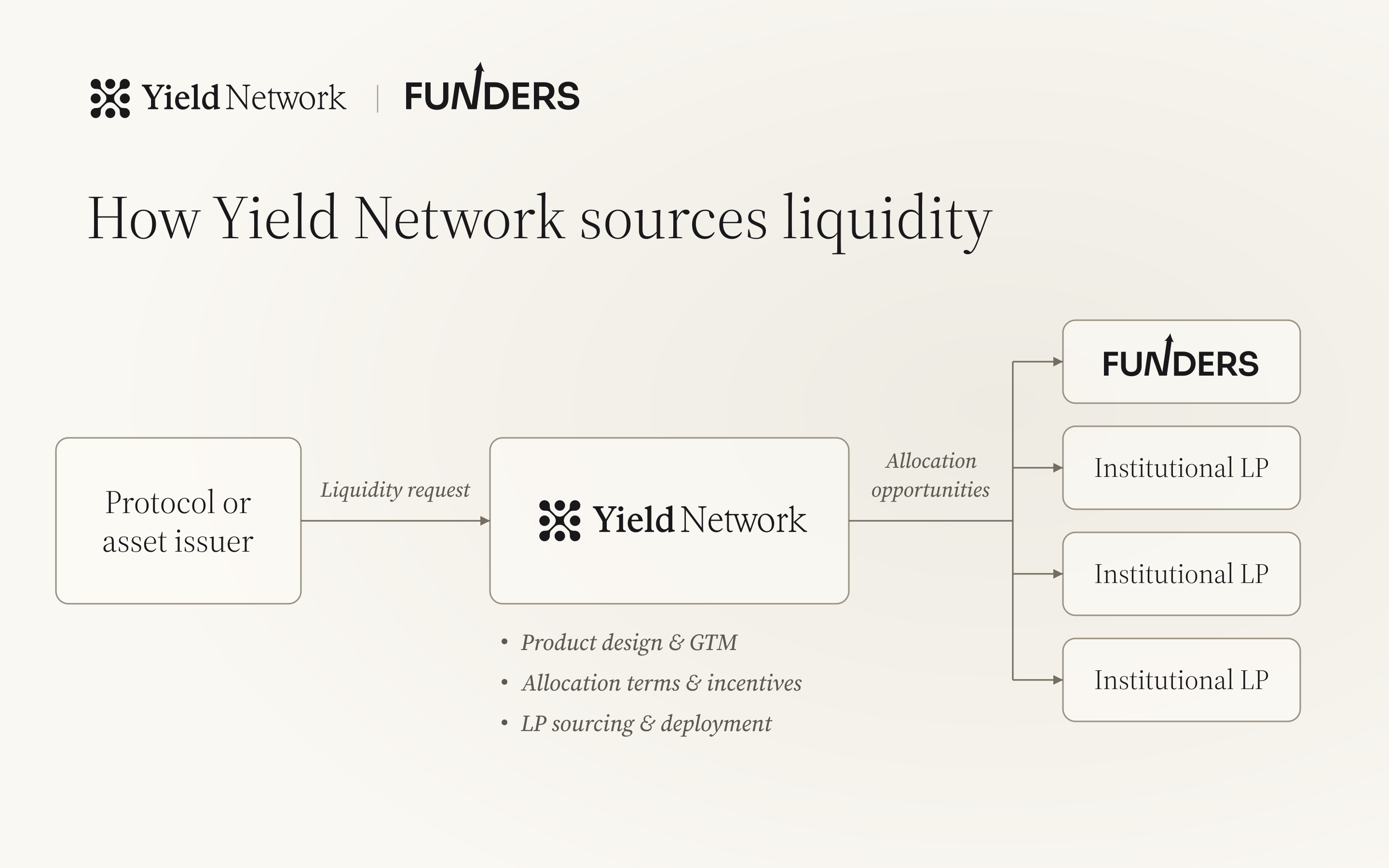
The rest comes through partners such as Yield Network, which connects us with protocols seeking liquidity and negotiates allocation terms for participating LPs. Sometimes we also work directly with teams to help grow the protocol, as we would with a venture investment.
4. When evaluating a new lending market or vault, what determines whether Funders will supply capital? What would make you reject an opportunity offering an attractive APY?
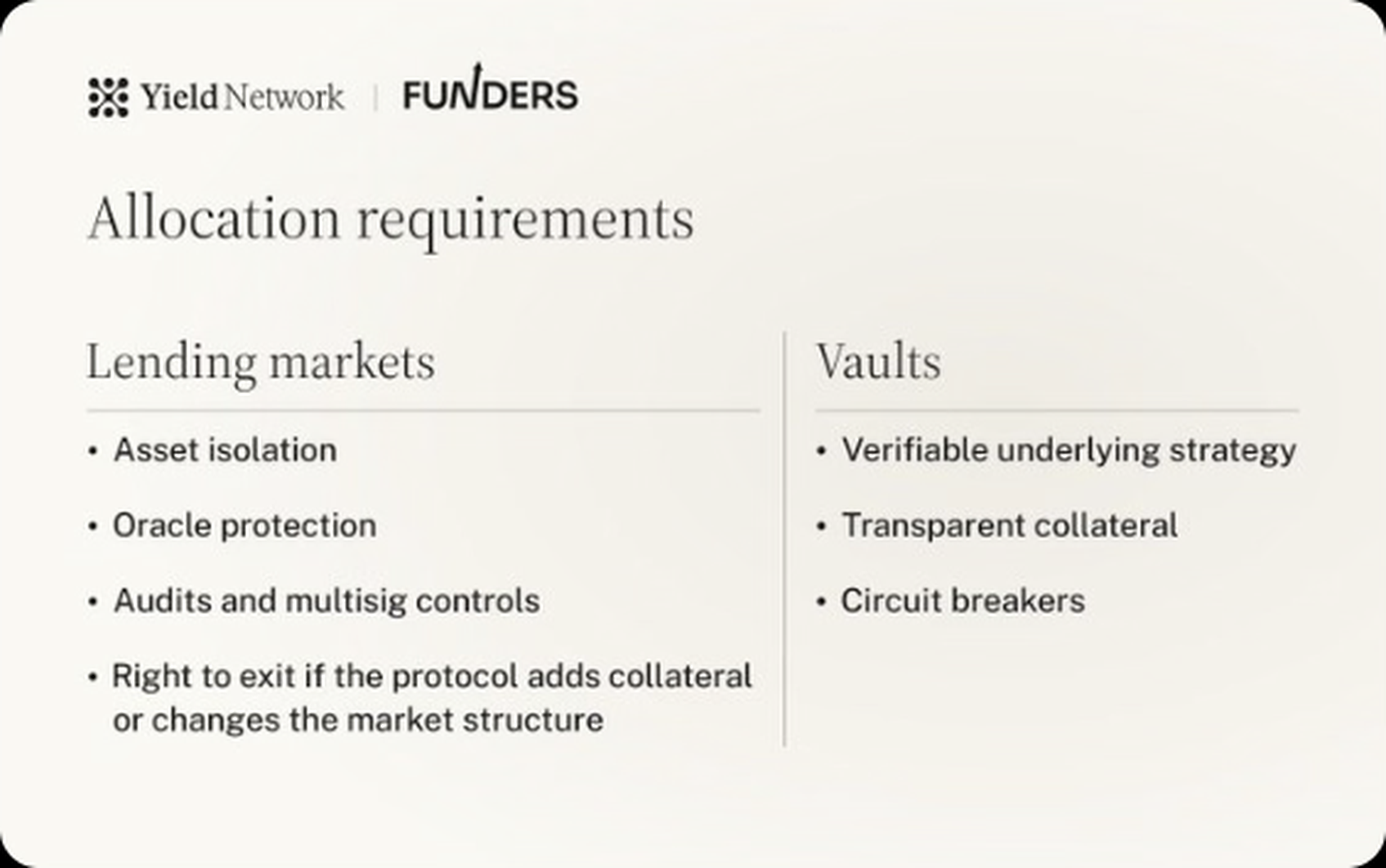
Funders: For lending markets, asset isolation is a requirement. We want to limit the risk that a failure involving another token or oracle affects our position.
Our diligence covers oracle protection, audits and multisig controls. We also need the right to exit if the protocol adds a new collateral asset or changes the market structure.
For vaults, the underlying strategy must be verifiable and the collateral asset has to be transparent. We also require circuit breakers. If we cannot properly evaluate the risk, we pass regardless of APY.
5. Do you have any limits on exposure to a single protocol?
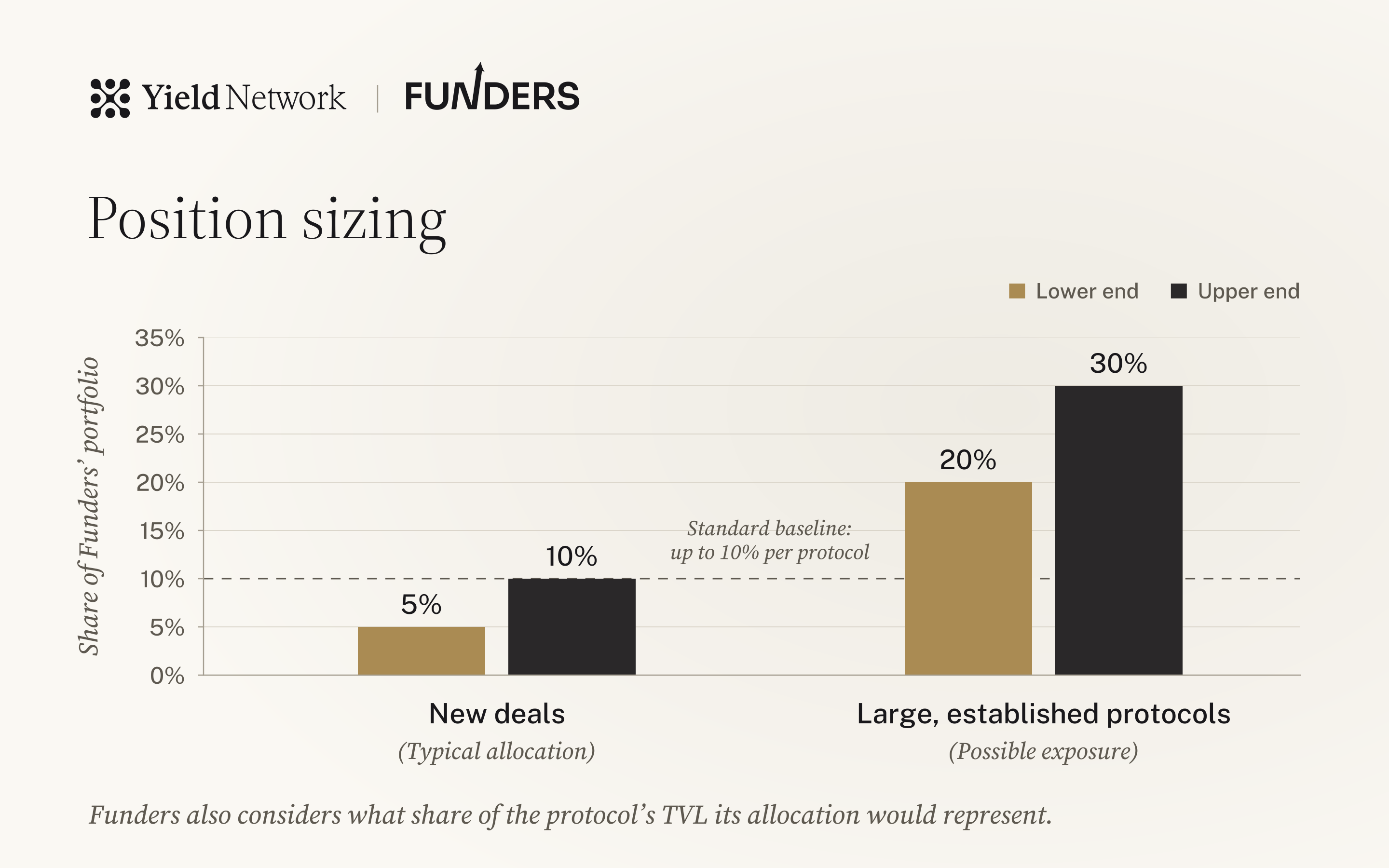
Funders: Our baseline is up to 10% of the portfolio per protocol. New deals generally receive 5–10%. Exposure to large, established protocols may reach 20–30%.
The allocation size also depends on the protocol's TVL and the proportion of it our position would represent.
6. How do you compare native yield with returns that include token incentives?
Funders: Yield quality matters to us but our investors also expect double-digit returns.
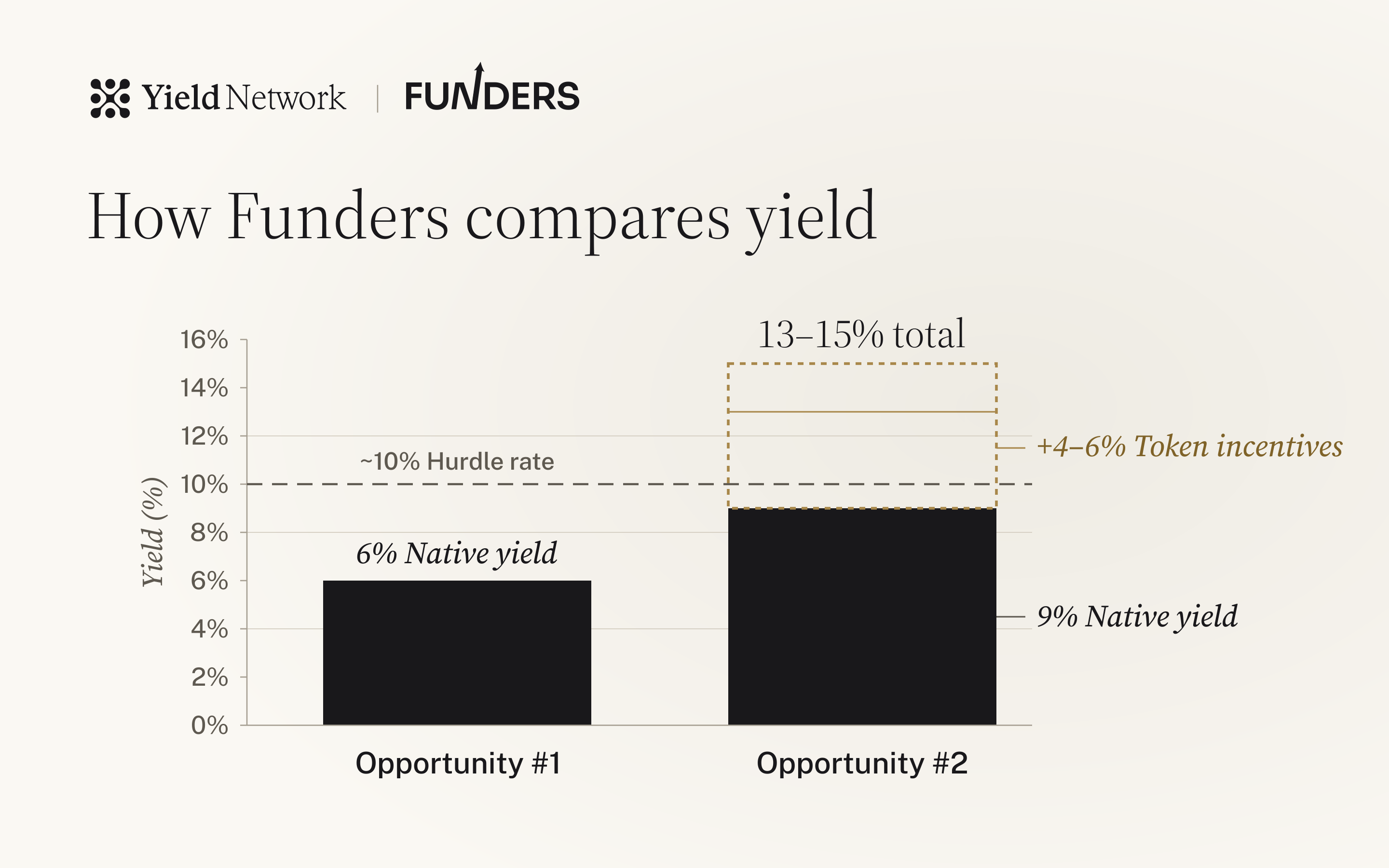
For example, we would usually prefer 9% native yield plus token incentives bringing the total to 13–15%, compared with flat 6% real yield.
7. What is your hurdle rate, and what are your minimal opsec requirements?
Funders: Our hurdle rate is roughly 10%. On opsec we dig as deep as possible: how funds are held, who controls the keys, how the contracts are set up, and what circuit breakers are in place. The key question is what could go wrong.
8. How do you evaluate redemption liquidity? How do lockups affect your decisions?
Funders: Our monitoring queries pools directly. We check DEX exit liquidity and redemption queues, with triggers for rising slippage.
We accept longer redemption periods in RWA and private credit when we understand the risks. In other DeFi markets, we are seeing protocols move away from lockups because liquidity has become harder to attract following the hacks.
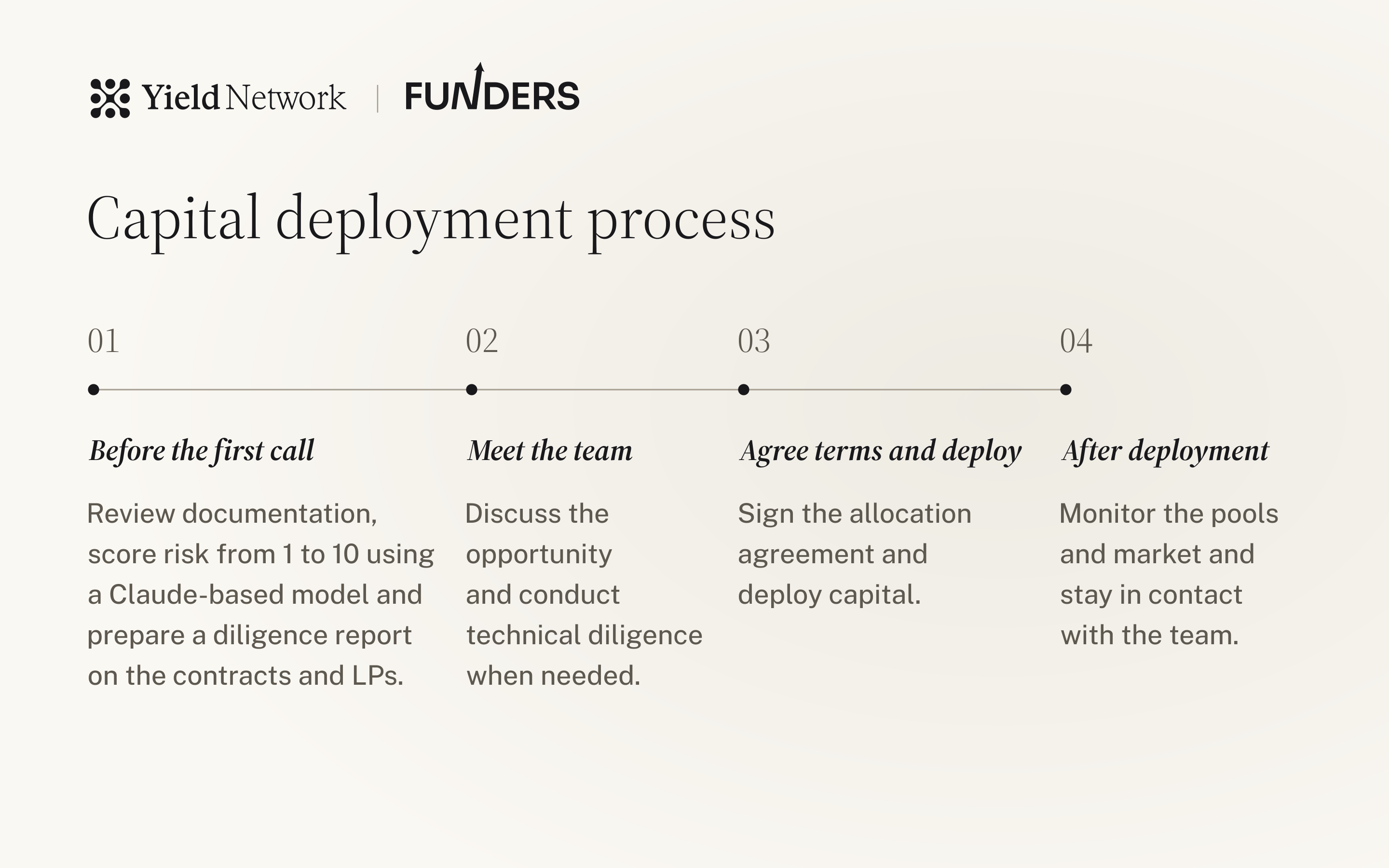
9. Walk us through the process from identifying an opportunity to deploying capital.
Funders: We start with the documentation and run the opportunity through our Claude-based risk-scoring model, which assigns a score from 1–10. Before any call, we generate a due diligence report covering the contracts and LPs.
We then meet the team, ask questions and sometimes conduct technical due diligence. If we proceed, we sign an agreement, ideally with better terms or a strategic partnership. For opportunities sourced through Yield Network, we receive the preferential allocation terms they negotiate for their LPs.
Once capital is deployed, we monitor the pools and market and stay in close contact with the team.
10. Where are the best risk-adjusted returns today? How has AI exploit risk impacted your DD process and allocations?
Funders: We see the most opportunity in RWA, especially fintech loans, though many are still poorly structured legally. We're also diversifying into delta-neutral trading strategies on CEXs.
On DD, AI is now built into our process from the first screen, and the wave of hacks has made us much stricter on contract security, admin keys and exit rights.
Conclusion
Thank you to the Funders team for sharing how they approach DeFi allocations. Their responses give protocols and asset issuers an institutional LP's perspective on how an offering is evaluated before capital is committed. Teams can use the requirements discussed here when developing their product and preparing the terms they will offer prospective LPs.
Yield Network works directly with teams on product design and GTM to help them attract institutional LPs. We source LP commitments and negotiate allocation terms. If you are launching a product or raising liquidity for an existing market, get in touch to discuss your product and capital requirements.
Funders' responses reflect its approach to DeFi allocations at the time of the interview. They are shared for informational purposes only and do not constitute investment advice, an offer or a recommendation to invest in any protocol, vault or strategy.
The yield figures are illustrative and do not reflect realized performance or guarantee future returns. DeFi allocations carry risk, including loss of principal. Readers should conduct their own due diligence before committing capital.