
Is Robinhood Chain's Growth Real?
 Yield Network
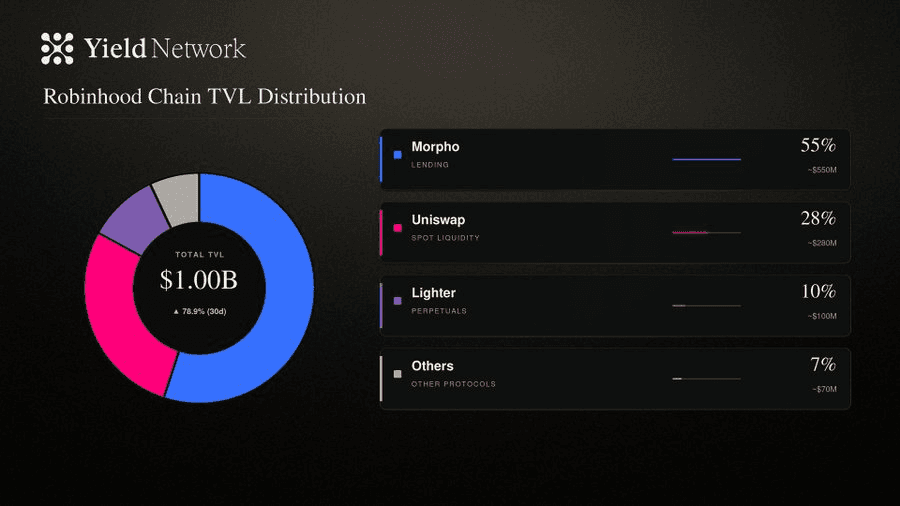
About $820M of Robinhood Chain's ~$1B in TVL is in 2 incentivized positions: USDe collateral on Morpho and the Robinhood Earn USDG vault. It looks good on paper but incentives and concentration makes us wonder how sustainable this is.
TVL reached ~$1B on September 20, up from $559M a month earlier.
Source: defillama.com/chain/robinhood-chain
Capital Renewed Week by Week
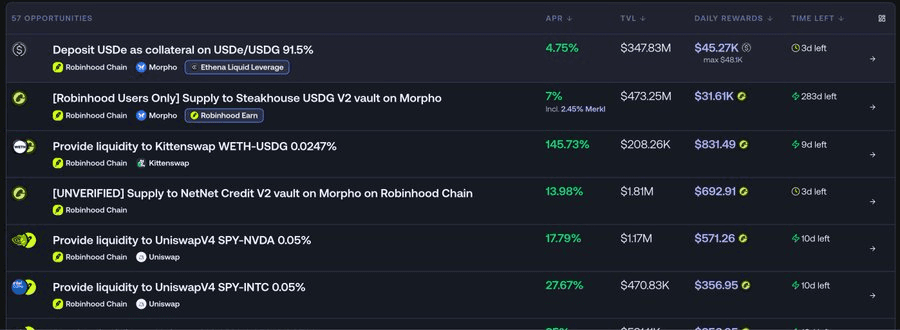
The USDe collateral program renews weekly on Merkl. Its budget rose from ~$173,000 to $319,000/week since late July alongside TVL growth, then stayed at ~$45,000/day over the past month.
As of September 21, Merkl reported $94,756/day in active incentives across 56 opportunities. USDe collateral received ~$42,550/day and the Robinhood Earn USDG vault about $41,870. Together, those 2 positions received ~90% of the listed daily rewards.
Source: app.merkl.xyz
Lower Fees Affected the Revenue
Robinhood Chain's daily fees fell ~94%, from a September 1 peak of $3.75M to ~$207,000. The decline does not indicate that activity fell as TVL grew. Robinhood raised the chain's gas limit, increasing capacity and lowering transaction costs.
Over the past 30 days, Robinhood Chain generated $38.86M in gross fees and retained $34.96M in net revenue, representing a retention rate of ~90%.
Sources: defillama.com/fees/chain/robinhood-chain, defillama.com/revenue/chain/robinhood-chain and x.com/hosseeb/status/2099548753271132424
Volume Needs the Same Scrutiny
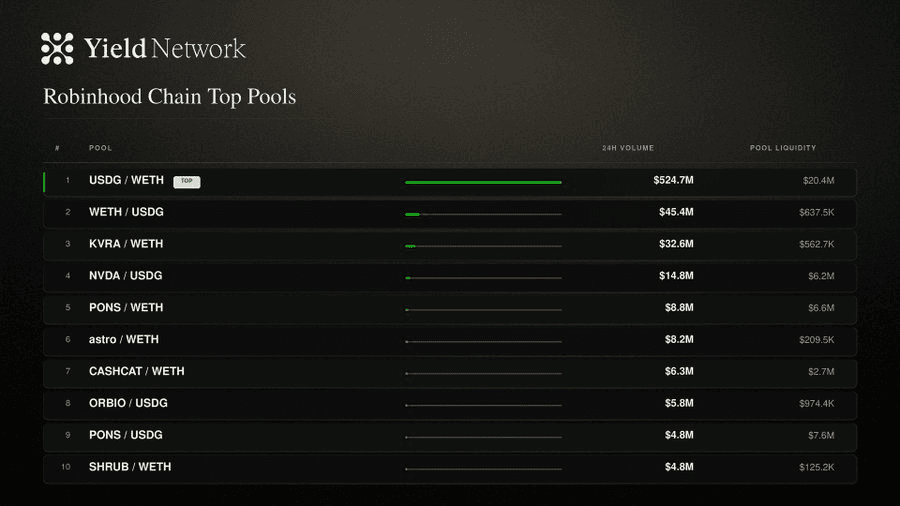
The USDG/WETH pool recorded ~$524M in daily volume against ~$20M in pool liquidity. Uniswap handled 84% of the reported $38.9B in monthly spot volume with the activity also spanning across tokenized stocks and memecoins.
Source: geckoterminal.com/robinhood/pools
On Morpho, the loan book nearly doubled in under 2 months to $461M, though borrowing growth slowed down in September and trailed TVL growth.
Pons and Uniswap were the largest fee generators. Pons generated ~$139.94M in fees over 30 days while Uniswap generated ~$134.23M in fees and $9.1 million in protocol revenue.
This proves activity is generating fees, but does not tell us how much of the underlying activity will persist without rewards.
So, Is the Growth Real?
Yes. Deposits, borrowing and trading are happening, but the largest capital positions are subsidized and the USDe program depends on weekly renewal. Robinhood Chain has shown that rewards can attract capital however is yet to show how much of that capital stays when rewards end.
For teams launching on Robinhood Chain, the test comes when incentives end and LP returns have to rely on the underlying strategy itself. If the economics no longer clear LP hurdle rates without the subsidy, deposits are likely to leave with the rewards.
Yield Network works with protocols, issuers and ecosystems to structure liquidity programs that can attract capital on terms that remain viable beyond the initial incentive period. We then bring those programs to LPs through our distribution network, with the focus on whether the underlying market can continue to support capital once the subsidies end.