Yield Network's Primer to Raising Onchain Liquidity in 2026
 Yield Network
Executive Summary
After more than a year of structuring liquidity campaigns and speaking with LPs, asset issuers and protocol teams, a few patterns show up consistently:
- APY gets attention, but yield source, net return, capacity and downside potential determine whether capital gets allocated.
- Transparency requirements have expanded beyond smart contract audits and PoR dashboards into multisig setups, counterparty exposure, timelocks, scalability, legal structure and withdrawal mechanics.
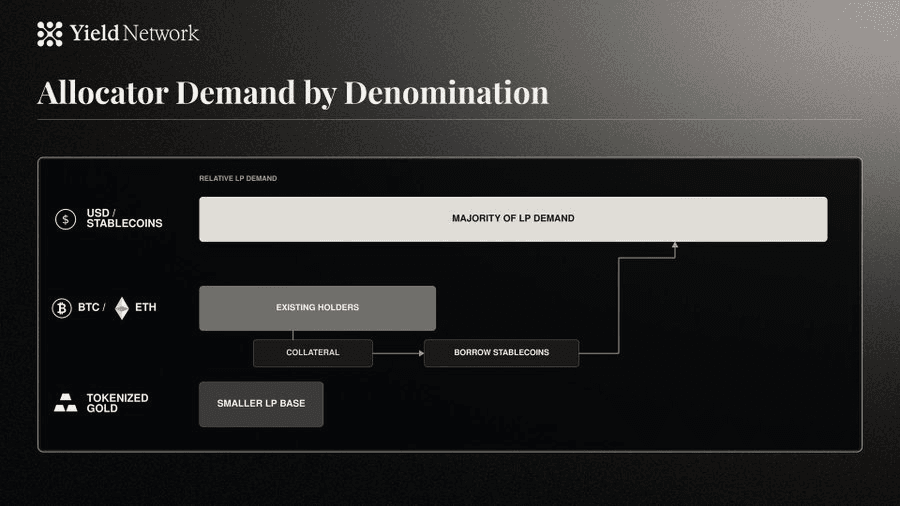
- USD remains the leading denominator across the allocator demand we see.
- Vault infrastructure and risk managers increasingly affect whether an LP is willing to underwrite a new strategy.
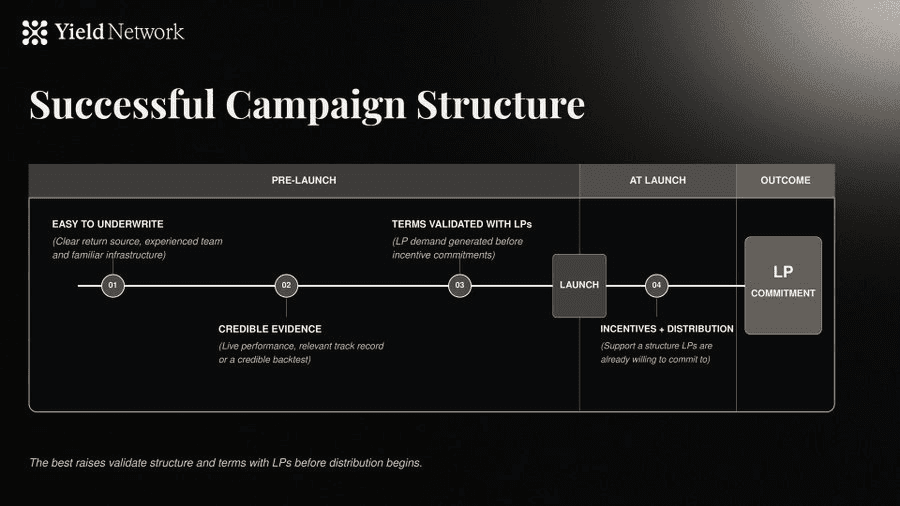
- The best raises validate structure and terms with LPs before distribution begins.
The broader change is that professional LPs are underwriting more variables than they were a year ago. RWAs and strategies with offchain components now represent more than half of the opportunities we see, which means a larger share of diligence happens beyond smart contracts and onchain exposure.
At the same time, the security environment has become more demanding. AI tooling has made vulnerability discovery faster and more accessible, while the continued frequency of exploits this year has raised the security threshold LPs expect a strategy to clear before they can deploy capital.
Strategy Evaluation Framework
1. The Evolution of Transparency Standards
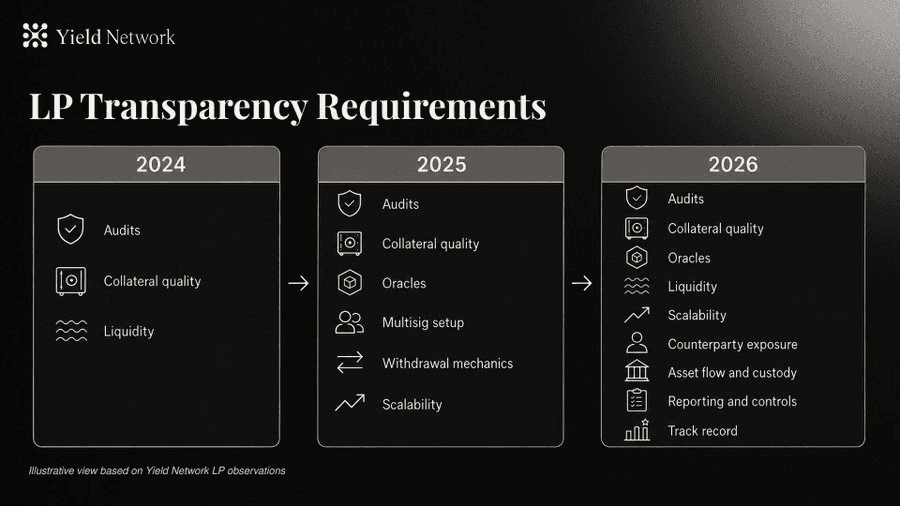
A protocol's transparency framework used to be relatively easy to define. For an onchain lending strategy, an LP could inspect smart contract audits, collateral quality, oracles and available liquidity without relying heavily on information provided by the manager.
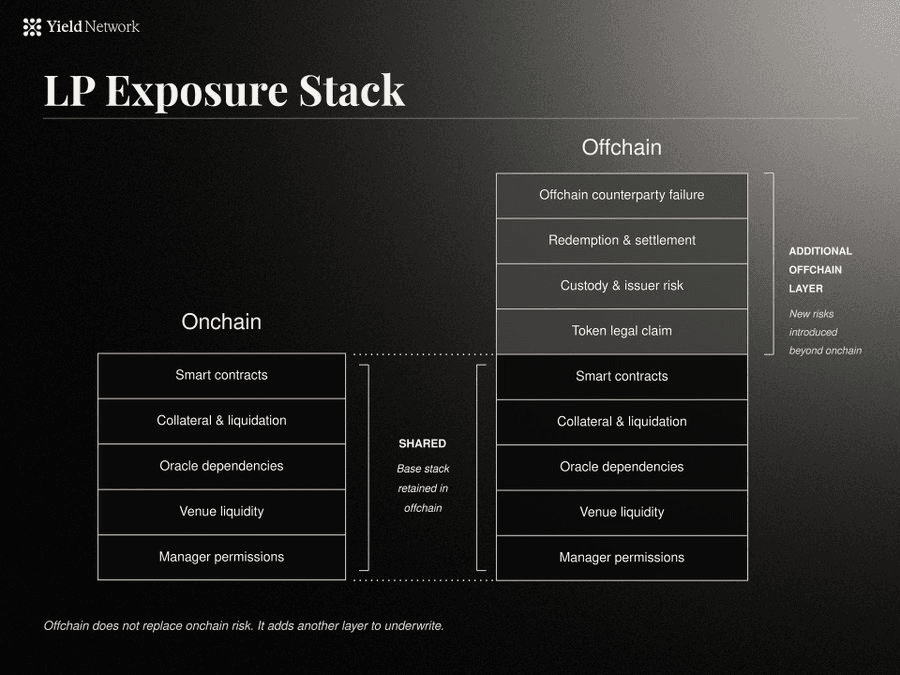
This diligence process becomes insufficient once part of the strategy moves offchain. A tokenized fund, market neutral strategy or RWA product can introduce numerous counterparties between the depositor and the assets generating the return. At that point, LPs are underwriting the reporting and control framework around the strategy alongside the underlying assets themselves.
Operational history has also become an important part of LP research. A new strategy may have audited contracts and detailed documentation, but allocators still want evidence that the team has run the strategy with live capital or has a relevant track record in the field. For products with offchain components, that history matters even more — parts of the strategy cannot be verified continuously onchain. An operational track record gives LPs evidence that the strategy has historically performed as described before they commit capital.
2. Does the Headline APY Matter?
The quoted APY is often the first filter in an LP's evaluation, determining whether a strategy clears the required return threshold and warrants further diligence. Once it does, the focus shifts to how that return is generated and whether it is sustainable. LPs assess how much of the yield comes from the underlying strategy, how much depends on incentives, whether there are fees that reduce the gross return, and whether the stated APY is supported by realized net performance.
This becomes particularly important for new strategies. Without a live track record, LPs may want evidence from the manager's previous products, relevant backtesting data, or an APY floor that reduces uncertainty during the initial deployment period. If incentives contribute to the quoted APY, LPs want to know what the strategy yields once those incentives expire.
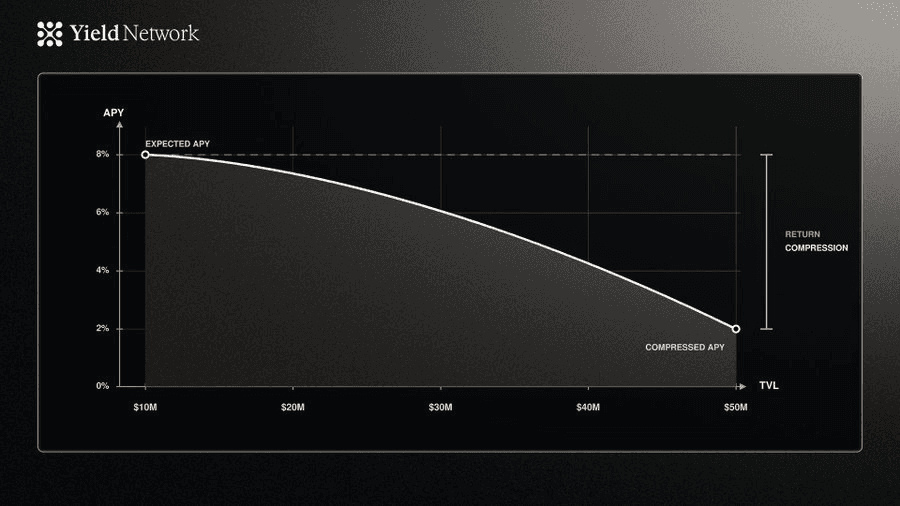
The strategy's scalability is the next variable that needs to be underwritten. LPs want to know whether the strategy can maintain its expected APY as more capital enters — a rate that works at $10M TVL can compress at $50M. For larger allocators, the relevant question is how much capital can be deployed before the strategy's performance begins to deteriorate.
3. Most Common Questions Asked by LPs
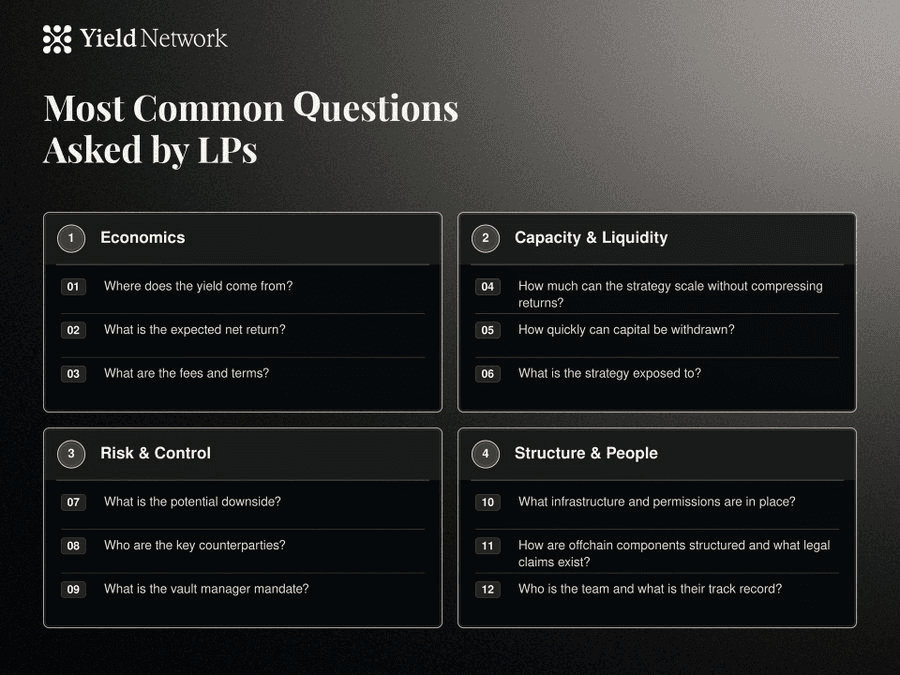
The two questions we hear most often are straightforward: where does the yield come from, and what is the potential downside?
The yield source is only the first layer of diligence. LPs then separate base yield from incentives and assess how those incentives are paid — including whether they are liquid or subject to vesting. A quoted APY partly paid in a vested token does not offer the same realizable return as the same rate paid in the deposit asset, because the token's value and liquidity determine what can ultimately be captured. The next question is what remains once incentives end, since that residual yield is what the strategy needs to support on its own.
Most of the remaining diligence is an attempt to answer the downside question. For lending strategies, that means understanding the collateral quality and the conditions under which bad debt can occur. A leveraged strategy requires a clear explanation of borrow rates, how the position is redeployed and what the liquidation thresholds are. A market neutral strategy needs to explain the hedge and the spread being captured. An RWA strategy needs clearly established information on the depositor's claim on the underlying assets and how that claim is treated if an offchain counterparty fails.
Additionally, allocators examine whether asset redeemability is affected during periods of market stress. A position that is easy to exit in normal conditions can become difficult to unwind during a depeg or a period of sudden low liquidity, leaving a solvent strategy unable to meet withdrawals on schedule.
Another point is the scope of the curator mandate after deposits are made. LPs want asset and allocation limits defined upfront so the vault's asset flow does not change beyond the strategy they originally underwrote.
4. USD-Denominated Strategies Still Capture Majority of Demand
USD and stablecoin strategies account for the majority of allocator demand we currently see. The reason is mainly portfolio composition. A USD strategy lets an LP isolate the return generated by the strategy without adding any price exposure at the same time. This makes the strategy easier to underwrite — an allocator can look at the net yield and decide whether it compensates for the additional smart contract or counterparty risk relative to other USD-based opportunities.
BTC and ETH-denominated products still attract capital, particularly from holders that already own the underlying asset. We also see those assets used as collateral to borrow USD, with the borrowed stablecoins then deployed into yield strategies. In practice, most of the demand still comes back to USD.
Gold-denominated products are developing as tokenized gold becomes usable in lending and leverage strategies, but the potential LP base remains small. Asset denomination affects the potential size of the raise before a protocol starts compressing APY or adding incentives.
5. Underlying Infrastructure Is Now Part of LP Diligence
Vault infrastructure has become a core part of LP diligence. It defines the curator mandate and the permissions governing how capital can be deployed after being deposited. Established infrastructure gives allocators a known operating framework and reduces the amount of new vault-specific risk they need to underwrite alongside the strategy.
Across our mandates, clients have repeatedly chosen established vault providers before going to market. Several of those launches went on to attract substantial LP deposits, and three partners in particular have become recurring choices for teams raising capital.
Ember
Ember Protocol originates assets and provides the infrastructure to bring any fund, vault, strategy or asset onchain, supporting managed strategies across DeFi, CeFi and RWAs — the Vault Manager controls the strategy while Ember provides the underlying vault infrastructure. Its contracts have been through 10 audits, are formally verified, and vaults surface historical returns, fees and strategy exposure so LPs can evaluate both the infrastructure and the strategy before allocating. Ember's upcoming atomic credit facility and junior capital tranche add further tooling across the product suite.
Ember works with the largest asset managers in the space. Bitwise ($11B+ AUM) uses Ember as the infrastructure layer for PPLUS, its first high-yield onchain product, which we helped raise $10M for. Securitize chose Ember as its only day-one partner for the launch of its high income bond fund with Neuberger Berman, with Ember being the largest driver of deposits into the product. Ember also originated the Hilbert Group regulated Bitcoin fund, which took in over $10M in its first week. Around $120M is actively deployed across the platform today.
We have used Ember infrastructure across multiple live capital raises, including the Pharos RealFi Ecosystem Vault. Ember's existing operating history gave LPs a proven infrastructure layer to evaluate, helping support the $50M raised for the vault through the YN Syndicate. Additionally, Y10k Capital — our asset management arm — uses Ember for the flagship Y10k USD Vault, focused on curating private onchain liquidity deals.
Morpho
Morpho is a permissionless lending protocol built around isolated lending markets and curated vaults. Each market defines its collateral, loan asset, oracle and LLTV at deployment, while curators allocate across eligible markets under predefined exposure limits.
Morpho has been live since 2022, giving the protocol over 4 years of operating history. Its core contracts have undergone extensive independent audits and formal verification, with the protocol scaling to ~$9.5B in TVL.
Y10k Capital uses Morpho as the underlying lending infrastructure for its PYUSD vault on Sei, with RockawayX managing allocations across isolated markets under the vault mandate.
Upshift
Upshift Finance provides vault infrastructure for strategies spanning DeFi, CeFi, over-the-counter and tokenized assets, with Upshift's policy engine enforcing the curator mandate at execution and restricting capital to approved parameters. Upshift has ~$500M in total deposits and works with firms including Kraken Institutional and Securitize, giving LPs an established infrastructure layer to evaluate alongside the strategy.
We have used Upshift infrastructure across multiple capital raises, including campaigns for Tori, Citrea, Fluent, Ink, Axis and others. Across these launches, Yield Network has raised over $80M, with Upshift providing the vault infrastructure used to accept LP deposits and calculate NAV.
Established vault infrastructure gives allocators a known operating framework before a new strategy goes live. Production history and a clearly defined curator mandate reduce the amount of infrastructure-specific diligence required alongside the strategy.
6. Oracle Infrastructure
Robust valuation and data infrastructure is a bare minimum for generating serious LP demand. An unreliable or poorly configured price feed can turn an otherwise sound asset into an unacceptable collateral risk if it doesn't aggregate prices from enough markets and implement anti-manipulation limits.
RWAs introduce a whole new dimension to this. Some trade on venues that only operate within designated market hours; others, such as commodity futures, trade with rollover schedules. And RWAs like money-market funds should not be valued based on trading — their share price is instead determined from NAV reports from fund administrators.
Redstone provides data and valuation infrastructure for pricing assets used across lending and onchain credit markets. Its modular architecture supports standard liquid crypto assets as well as complex collateral such as yield-bearing tokens and RWAs, where pricing relies on underlying NAV, verified reserves, or primary offchain attestation data.
We see data infrastructure quality as part of the asset itself when assessing whether it can attract LP demand. RedStone's infrastructure secures over $10B in value across 110+ networks, its contracts have undergone 15 independent audits, and it maintains a track record of zero mispricing incidents as of publication. For protocols bringing new collateral into lending markets, having an established data and valuation provider in place removes one of the first infrastructure questions sophisticated LPs will raise.
7. Incentive Distribution
Incentives are a useful tool for helping campaigns reach initial scale. They can improve the economics for early suppliers and concentrate liquidity around a new asset, while the distribution layer determines whether those rewards actually reach the positions the program is designed to support.
Merkl handles incentive distribution for lending and liquidity programs, tracking which positions qualify and calculating rewards against the campaign rules. It has distributed more than $1.6B in incentives to date.
We used this structure while helping build the PYUSD market on Sei Network, where Sei distributed rewards to lenders through Merkl. The market scaled to ~$55M in deposits and continued to hold substantial liquidity after the initial incentives were reduced. This is where incentives work best: helping a new market establish enough liquidity and utilization for the underlying lending economics to sustain LP participation.
8. Offchain Strategies Introduce Trust Assumptions
Purely onchain strategies give allocators a higher degree of independent verifiability, with portfolio state and execution observable directly onchain. This does not remove smart contract or oracle risk, but it reduces reliance on manager reporting.
Offchain strategies reduce how much of the asset flow LPs can verify directly. Once capital is moved to an external counterparty, they rely on third-party reporting to confirm the underlying exposure and its performance. This additional dependence raises the return hurdle, especially where the exposure cannot be independently verified in real time or carries material counterparty risk.
9. Qualified Risk Management
Risk curation has become a core part of how LPs evaluate managed vaults. The curator's mandate directly determines the vault's risk profile by setting the boundaries within which capital can be deployed. LPs evaluate the manager's track record and underwriting discipline as part of the allocation decision.
A credible risk manager gives LPs a defined framework for evaluating new exposures and controlling concentration as the vault's allocation changes. This becomes increasingly relevant as mandates expand across more protocols and collateral types.
RockawayX is a multi-strategy digital asset investment firm with $2B+ in AUM across its verticals and more than $1B deployed across DeFi through its liquidity business. Its dedicated vault curation arm separately manages $150M+ across onchain vaults, applying RockawayX's underwriting framework to exposure selection, allocation limits and ongoing risk management.
Y10k Capital uses RockawayX to manage risk across its vault strategies, with RockawayX responsible for implementing the mandate as allocations change over time.
10. What Successful Liquidity Campaigns Have in Common
The raises that perform best usually make the investment case easy to underwrite. LPs can understand why the return exists, see evidence that the team can manage the strategy and evaluate the product on infrastructure they already know.
Live performance carries the most weight. Where that history does not yet exist, a relevant manager track record or credible backtest can help bridge the gap. Experienced risk managers and established vault providers can also shorten diligence for newer products by reducing the number of unproven components around the strategy.
The commercial structure still has to work for the target LP base. Successful campaigns tend to validate terms with allocators before launch, then use incentives and distribution to support a structure that LPs are already willing to commit.
How Yield Network Approaches Liquidity Raises
Before going to market, the campaign needs a structure LPs can underwrite. The raise should be sized around the strategy's actual capacity, with withdrawal terms and incentives set around how the capital will be deployed and how quickly it can be returned.
Yield Network builds that structure and then validates it with LPs in the Yield Syndicate before launch. We use their feedback to understand how much capital the market can support, which terms are likely to clear LP hurdle rates and what needs to change before the protocol commits its incentive budget.
Once the structure is validated, we coordinate the infrastructure required to launch and, where the mandate includes execution, source commitments and manage allocation through settlement. After launch, we track whether capital remains in the program and how efficiently the incentive budget is being used.
The goal is to take a structure to market that has already been tested with the LPs expected to fund it.
Looking to structure and raise liquidity? Apply here.