Stable Raised $2.6B in Pre-Deposits Across Two Phases. Both Had Problems.
 Yield Network
The Setup
Stable launched in mid-2025 with a clear thesis: build a high-performance, EVM-compatible Layer 1 purpose-built for USDT. Not a general-purpose chain. Not a multi-stablecoin ecosystem. A single-asset payments rail — sub-second finality, ultra-low fees, gas paid in USDT, with the STABLE token reserved for governance and network security.
The backing was serious. $28M seed from Hack VC and Bitfinex. A strategic investment from Gabriel Abed (Bitt founder, Barbados central bank digital currency architect). And in September 2025, PayPal invested — a signal that institutional capital saw Stable as infrastructure, not speculation.
By October 2025, the team was ready to bootstrap mainnet liquidity through a pre-deposit campaign. What followed was a two-phase experiment that demonstrated both the worst and best practices in capital formation — sometimes in the same campaign.
Phase 1: $825M in 22 Minutes, One Wallet Got 60%
October 24, 2025
Stable announced Phase 1 of its pre-deposit campaign with an $825M cap. The vault was built by Concrete, with deposits deployed on Morpho (curated by Gauntlet) to generate yield while capital waited for mainnet. Pendle markets went live for the vault receipt tokens (ctStableUSDT, ctStablefrxUSD), giving depositors secondary market exposure. Halborn audited the vault contracts.
The infrastructure stack was institutional-grade: Concrete (vault), Morpho (yield), Gauntlet (risk curation), Pendle (secondary markets), Frax (additional stablecoin liquidity via frxUSD), USDT0 (native stablecoin standard), and LayerZero (cross-chain bridging to mainnet).

The cap filled in approximately 22 minutes.
The front-running problem
Then the on-chain data told a different story.
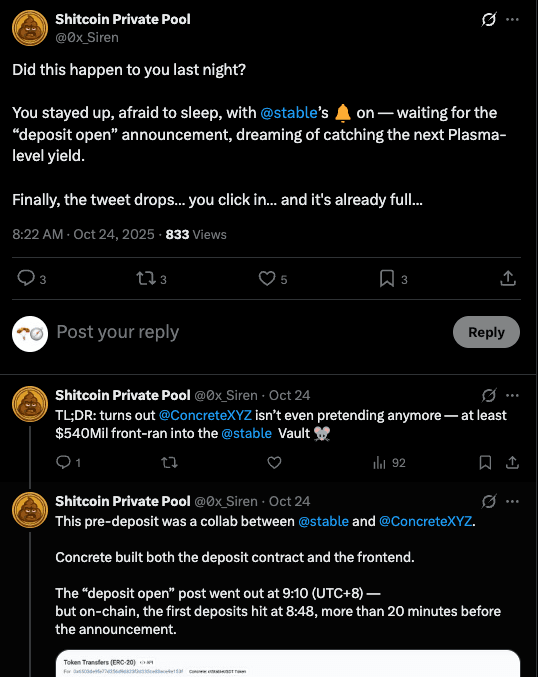
Community observers and on-chain analysts flagged that the vault had been substantially filled before the public announcement. One entity wallet reportedly contributed over $500M — more than 60% of the total $825M cap — with deposits hitting the contract before the "deposits open" tweet went out.
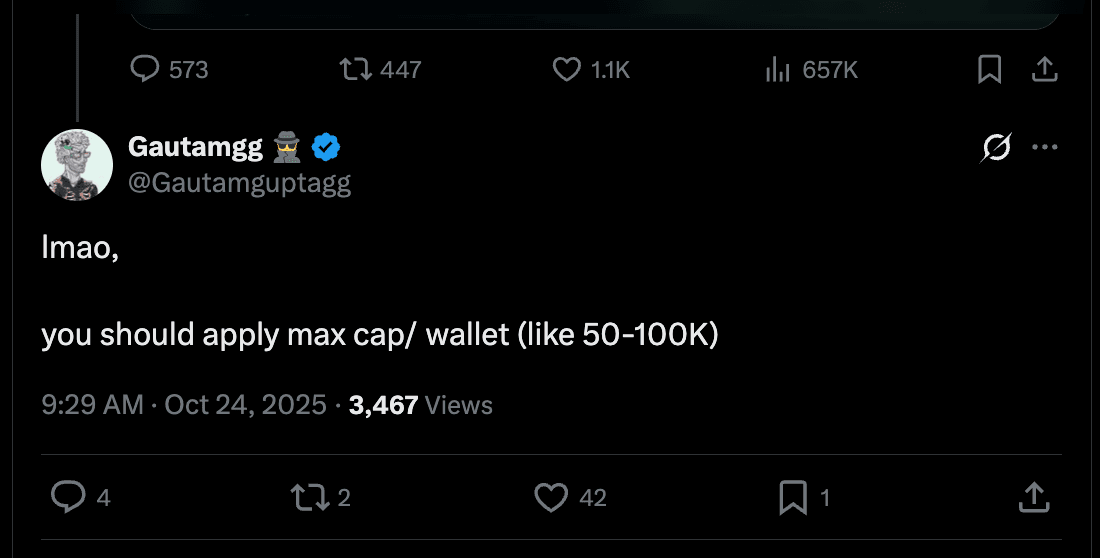
The analysis showed the deposit open post went out at 9:10 UTC+8, but on-chain, the first deposits hit the contract at 8:48 — more than 20 minutes before the announcement. Concrete had built both the deposit contract and the frontend. The implication was clear: entities with early access to the contract address could deposit before the public even knew the campaign had started.
The concentration problem
Reports indicate only approximately 194–274 unique wallet addresses participated in Phase 1. For an $825M raise, that's an average deposit of $3–4M per wallet. One entity took 60%+. The top handful of wallets captured the vast majority of the allocation.
There were no per-wallet deposit caps. No whitelist. No timed countdown. The launch time was unannounced — it simply appeared as a tweet.
The result: a pre-deposit campaign designed to bootstrap broad-based community liquidity was functionally captured by a small number of large wallets with privileged access to the contract address.
Phase 2: The Attempted Fix
November 5–6, 2025
Stable announced Phase 2 twelve days later, explicitly framed as a response to Phase 1's concentration issues. This time, the campaign partnered with Hourglass (institutional yield infrastructure) and introduced meaningful structural changes.

What changed
Phase 2 was a deliberate redesign across five dimensions:
- Per-wallet deposit limits. $1K minimum, $100K maximum for the first hour, $20M thereafter. This was the single biggest structural improvement — directly addressing the whale concentration that defined Phase 1.
- 24-hour countdown. Phase 1 launched at a random time. Phase 2 was announced with a fixed, public countdown, giving all participants equal preparation time.
- KYC requirement. Sumsub identity verification required within 48 hours of deposit. Chainalysis wallet screening. One-wallet-per-user rules to prevent multi-wallet sybil attacks.
- Terms of service. Participants had to sign TOS before depositing — adding a compliance layer absent from Phase 1.
- Pro-rata allocation. With a $500M deployment cap and anticipated oversubscription, Hourglass designed a pro-rata model: guaranteed $1K minimum per participant, with amounts above $1K allocated at approximately 45%, remainder refunded via Merkle.

The vault was audited by Zellic. Deposits went into USDC on Ethereum mainnet, converted to pre-iUSDT receipt tokens, with KYC-verified deposits eligible for deployment on Stable mainnet via LayerZero bridge.
What still broke
Despite the structural improvements, Phase 2 had its own infrastructure failures.
KYC bottlenecks. Multiple participants reported failed verifications, delayed approvals, and confusing flows on the Hourglass dashboard. Users who deposited on time but couldn't complete KYC within the 48-hour window were excluded — their deposits refunded but their participation denied.
System lag and DDoS. Hourglass reported a DDoS attack targeting backend infrastructure during the deposit window. This caused system lag, stuck transactions, and inability to accept terms of service in the UI. The team had to adjust participation requirements mid-event to accommodate affected users.
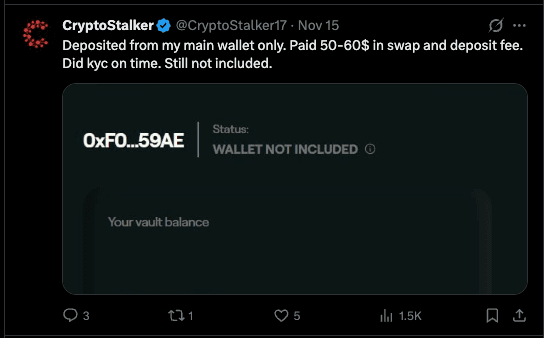
Wallet eligibility confusion. Users who completed KYC found their wallets marked "NOT INCLUDED" without clear explanation. Others were flagged as sybil despite being legitimate single-wallet participants. The criteria for inclusion vs. exclusion were not fully transparent.

The results
Phase 2 ultimately attracted over 10,000 verified wallets contributing more than $1.1B in eligible deposits — significantly more demand than Phase 1's $825M despite far broader participation.
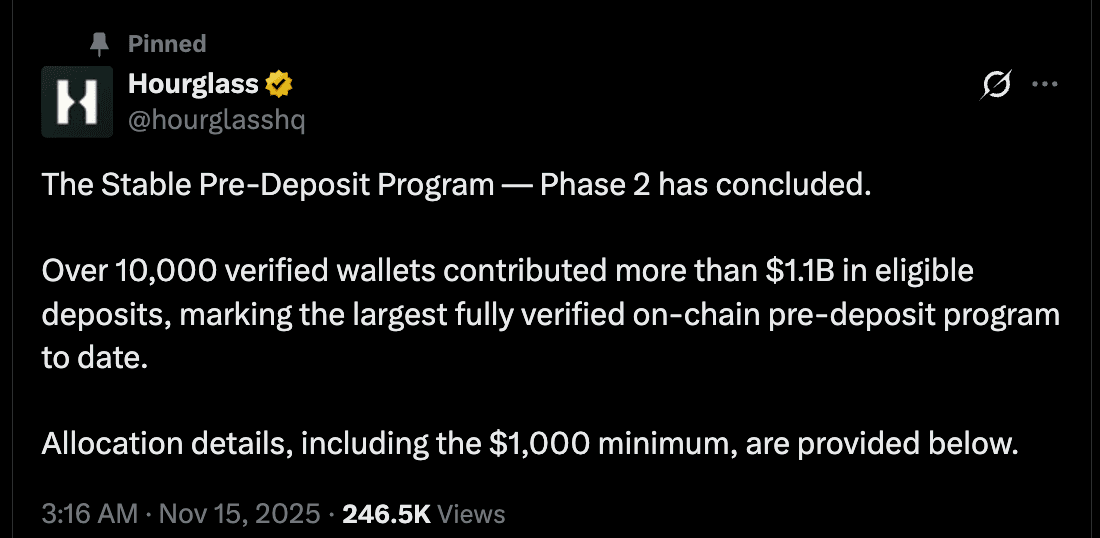
With the $500M deployment cap, the final pro-rata allocation was approximately 45% for amounts above the guaranteed $1K minimum. The remaining ~55% was refunded.
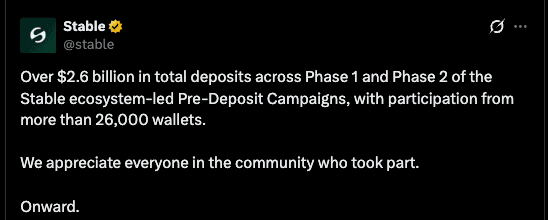
Combined across both phases, the pre-deposit campaign totaled $2.6B in deposits from over 26,000 wallets. Stable mainnet launched on December 8, 2025.
What Phase 1 Got Wrong
Phase 1's failures were structural, not technical. The infrastructure worked — the vault filled, deposits were deployed, yield was generated. The problem was who got in and how.
No per-wallet caps meant a single entity could (and did) take 60%+ of the allocation. In a campaign designed to build a community of liquidity providers, this produced the opposite outcome: extreme concentration in a handful of wallets.
No pre-announced launch time created an information asymmetry where entities with early contract access could front-run the public announcement. When on-chain data shows deposits hitting 20+ minutes before the tweet, the "open to all" framing collapses.
No KYC or eligibility screening meant there was no mechanism to enforce distribution fairness, prevent multi-wallet concentration, or ensure the depositor base represented genuine future network participants.
The result: $825M raised in 22 minutes, 194–274 wallets, one entity reportedly capturing 60%+. High efficiency, zero fairness.
What Phase 2 Fixed — and What It Didn't
Phase 2 corrected the fairness problems. Per-wallet caps, KYC, one-wallet-per-user rules, a published countdown, and pro-rata allocation with a guaranteed minimum all directly addressed Phase 1's concentration dynamics. The outcome — 10,000+ wallets, $1.1B in demand, broad distribution — validated that these design choices work.
But Phase 2 introduced a different class of problems: infrastructure under load.
KYC at scale is hard. When tens of thousands of participants need to verify through a third-party provider within a compressed window, verification bottlenecks become participation bottlenecks. Users who wanted to participate and had capital ready were excluded because the compliance infrastructure couldn't keep up.
DDoS attacks during deposit windows are predictable threats for high-profile campaigns. Backend resilience, rate limiting, and fallback procedures should be architected before the event, not patched during it.
And mid-event adjustments to participation requirements — however well-intentioned — create the same trust deficit as Phase 1's information asymmetry. Changing rules during a live campaign, even to accommodate more participants, signals that the process wasn't fully planned.
The Two-Phase Lesson
Stable's pre-deposit campaign is unusually instructive because it ran the same experiment twice with different parameters and produced different failure modes.
Phase 1 optimized for speed and simplicity. No caps, no KYC, no countdown. Result: filled fast, captured by insiders, community excluded.
Phase 2 optimized for fairness and distribution. Caps, KYC, countdown, pro-rata allocation. Result: broad participation achieved, but infrastructure failures created a different set of excluded participants.
Neither phase was a clean execution. But Phase 2's problems are solvable engineering challenges — scale KYC infrastructure, harden against DDoS, pre-test under load. Phase 1's problems are design failures that no amount of engineering can fix after the fact. You can't un-concentrate deposits that already landed.
The progression from Phase 1 to Phase 2 maps directly to the maturity curve of capital formation infrastructure:
- Per-wallet caps are non-negotiable for any campaign targeting broad participation.
- Published timelines with pre-announced countdowns eliminate information asymmetry.
- KYC and eligibility screening enable distribution fairness but require infrastructure that can handle peak demand — not average demand.
- Pro-rata allocation with guaranteed minimums protects small participants from dilution in oversubscribed events.
- Third-party dependencies (KYC providers, backend infrastructure) must be stress-tested at 10x expected load, with DDoS mitigation as a baseline assumption.
- Rules must be set before the event and not changed during it. Contingency paths should be published, not improvised.
Stable got from zero to most of these principles in twelve days. The question for every protocol running a pre-deposit campaign is whether they need to learn these lessons the hard way — or build on infrastructure that already has them baked in.
What's Next
Stable mainnet has been live since December 8, 2025. The STABLE token is trading. We're approaching the 90-day mark — the window where retention data becomes meaningful. TVL trajectories, stablecoin flows, protocol concentration, and token price dynamics will tell us whether the $1.3B+ in deployed pre-deposit capital actually stayed.